
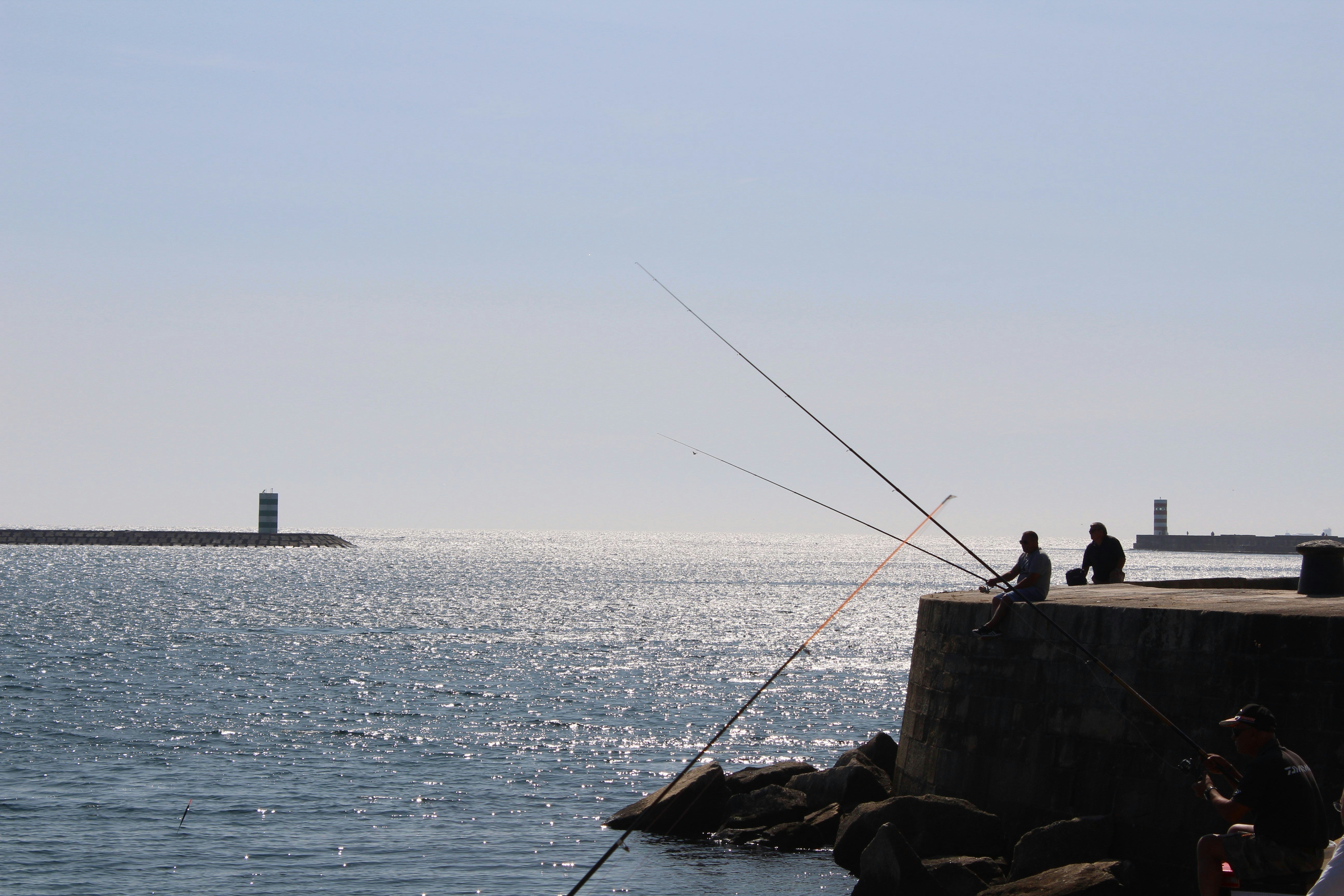
In North America, "telescopic rod" makes people think of a $19 pocket rod from a gas station. In Italy, France, and Spain, those same words can mean competition rods that serious anglers pay over $1,000 for. Same name, completely different animal.
European telescopics, especially Bolognese rods, do things a normal two-piece spinning rod just can't. Here's why one might end up being the most useful rod you own this year.

1. Transport: 20 feet of rod that fits behind your seat
A 6 m (19.7 ft) Bolognese collapses down to about 1.3 m (4.3 ft). For a lot of guys, that fact alone sells the whole idea.
Get that much rod any other way, and you're dealing with four or five loose sections, a hard tube, and somewhere to stash the tube. A telescopic just goes behind the truck seat, in the canoe, on a bike rack, or strapped to a daypack. No tube to lose. No sections rolling around the garage. Some of our customers carry theirs on a motorbike.
Our longest right now is the Trabucco Heaven BLS Extreme 6.0 m / 19.7 ft. Nearly 20 feet of reach, packed down no bigger than a broken-down 8 ft two-piece.
If packing small matters more to you than max reach, look at the Ultra-compact Sky Lab 350. It's a 3.5 m (11.5 ft) do-everything rod rated 20 to 50 g (0.7 to 1.8 oz), and it collapses small enough to fly as checked luggage with no rod tube. And it's cheap! Plenty of our customers just leave one in the trunk year-round.
3. The big one: fixed floats at real depth
A fixed float sits at one depth, held there by silicone sleeves. It's the more sensitive of the two float setups. Your shot stays exactly where you put it, the bait falls the way you meant it to, and when a fish lifts the bait you see it right away. A slider needs a stop knot and a bead; the shot has to pass through the float body, and you trade away some of that bite detection just to reach depth. Lines tangle more easily as well.
The catch: a fixed float only fishes about as deep as your rod is long, because that's how much line you can pick up on the strike. A 7 ft rod means roughly 7 ft of water at most. Fine along a shallow bank. Useless when the fish are sitting 15 ft down off a drop-off, which is exactly where trout head once summer warms the surface.
Length is the whole answer, and telescopic construction is what makes a long rod something you can actually carry. A 6 m (19.7 ft) Bolognese fishes a fixed float in 13 to 20 ft of water with all the sensitivity of a shallow rig. Around here that means rainbows and kokanee off a shelf, whitefish deep in winter, and perch stacked on structure, all on a float you can actually read.
Some summer days at Yellow Lake near Penticton, I've hooked trout on nearly every other cast while guys 20 feet away didn't land one. I'm not a better angler than them. I brought a 5 m / 16.4 ft European rod and put my bait where the fish actually were. They showed up with 6 ft rods and big red-and-white bobbers that spook the trout.
So how do you land it? Fair question, and worth being straight about. A fixed float set at 5 m (16.4 ft) means the fish won't reach your hand with the rod fully out. There are two fixes, and good Bolognese anglers know how to use either.
First, close the rod as the fish comes in. You draw the fish toward you and push the sections down one at a time while the line runs back through the guides, shortening the rod until the fish is in reach. It's standard practice, and it works. It's also a learned skill, and your first few tries on a good fish will feel clumsy. Practice on small ones.
Second, and this is the easier route we'd start you on, use a long-handled net. The Ignesti Premium Super Match Telescopic Carbon Fiber Landing Net Handle gives you 4 m (13.1 ft) of reach and is light enough to hold out one-handed. For shorter rods and closer work, the Globe Fishing Telescopic Landing Net Handle 3.2 m / 10.5 ft costs less and does the job. You'll need a net head too.
Honestly, a long net handle helps no matter what rod you're using. You'll land more fish simply because you don't have to drag them right to your boots first.
4. Line control a short rod can't buy
A long rod holds your line up off the water, and that one thing changes how a float behaves in current. The so-called "pesca alla passata." (No, it has nothing to do with pasta sauce.)
With 20 feet of blank you can lift your line clear of the near seam, let the float track the far seam at the speed of the water, and hold it back a touch to lift the bait right in front of a fish. On a short rod, the near current grabs your line, drags the float, and your presentation is wrong the second it lands. Fly guys spend real money chasing a drag-free drift. This is the float fishing version, and rod length is most of it.
Our practical pick here is the Tubertini Tatanka 1000, in 3.6 m (11.8 ft), 4.0 m (13.1 ft), and 4.2 m (13.8 ft). It handles heavier terminal weight than a pure match rod, 15 to 60 g or 15 to 80 g (0.5 to 2.8 oz), which makes it a true do-everything rod for rivers, lakes, and bombarda work.
What's a bombarda? If you haven't run into the word, it's Italian for a cannon, and that's about what it does. A bombarda is a weighted, torpedo-shaped float that slides on your line above a swivel, with 3 to 6 ft of leader down to a fly, a tiny spoon, or a single bait. On its own, that offering weighs nothing and won't cast. Behind a bombarda, it goes a hundred feet and more off a normal spinning reel. They come floating, slow-sinking, and fast-sinking, so you pick the depth you work. There's also a rattling version, called a maraca, with beads inside that click as it travels. That noise pulls in aggressive trout that ignore a silent presentation. If you've ever used a casting bubble for trout, this is that idea built properly, and it wants a longer rod with a soft tip so the cast loads instead of snapping the leader off.
5. Reach without casting
A long telescopic lets you place a bait instead of casting it. Swing the rig out, lower it, and the float lands with no splash and no line slapping the surface. On clear water that's been hammered all season, where trout spook off a cast shadow, that's the difference between a slow day and a good one.
For the lightest work, the Fly L'Incredibile 3.9 m / 12.8 ft is rated 1 to 20 g (about 1/32 to 3/4 oz) and built for exactly this: small floats, fine line, soft presentations.
6. It's not only about floats
Floats are where telescopics shine brightest, but they're not the only game. The Tubertini Beach Nexar 4.05 m / 13.3 ft is a telescopic surfcasting rod that handles up to 120 g (4.2 oz). Shore fishing with real weight, from a rod that still fits in a hatchback.
The honest trade-offs
We're not going to pretend these are free wins. Here's what you give up.
Weight. A telescopic runs heavier than a multi-piece rod of the same length and price. Nothing unreasonable; I was using 20 ft rods as an 8-year-old, but it's obviously heavier than a 7 ft rod.
Joints hate grit. Sand or silt in a joint is the enemy of these rods. Never extend a rod after laying it in sand, and never store it collapsed while it's wet.
Sections can stick. If you go overboard when setting them up via hard shoves instead of firm twists to deploy them, a section can occasionally stick. Just warm it with your hands and get rubber grip on both sides of the joint, and twist gently in opposite directions. Don't pull straight and don't reach for pliers.
A two-minute routine that doubles the life of the rod
- Rinse the rod extended with fresh water at the end of the day after salt or silty rivers.
- Let it dry or wipe every joint with a clean, dry cloth before collapsing.
- Store it collapsed out of the sun.

Which one should you buy?
| Rod | Length | Rating | Best for |
|---|---|---|---|
| Sky Lab 350 | 3.5 m / 11.5 ft | 20 to 50 g (0.7 to 1.8 oz) | Travel, backpacking, a rod that lives in the car |
| Fly L'Incredibile | 3.9 m / 12.8 ft | 1 to 20 g (1/32 to 3/4 oz) | Light floats, fine line, spooky trout |
| Tubertini Tatanka 1000 | 3.6 to 4.2 m / 11.8 to 13.8 ft | 15 to 80 g (0.5 to 2.8 oz) | One rod for everything, rivers and lakes |
| Tubertini Beach Nexar | 4.05 m / 13.3 ft | Up to 120 g (4.2 oz) | Shore and surf with heavier weight |
| Trabucco Heaven BLS Extreme | 6.0 m / 19.7 ft | Bolognese | Max reach, deep fixed floats, current control |
Buying one rod and not sure yet how you'll use it? Take the Tatanka. Already know you want fixed floats down deep? Go straight to the 6.0 m (19.7 ft) Heaven BLS and pair it with a long net handle.
Rigging it: what else you need
Floats. Bolognese floats are made to be fixed with silicone, not run as sliders. We stock Carbon Finesse Bolognese Floats from 1.5 g to 3 g (0.05 to 0.11 oz), Manni Finesse, Barbetta Finesse, and the long-stemmed Fly Bolognese Floats for windy days. See the whole lineup in Fixed Floats.
Silicone and stoppers. The Zepre Float Silicone Sleeves Box runs 0.05 mm to 2 mm (0.002 to 0.08 in), which covers everything you need to fix a float properly if you opt for a sliding float setup. Vincent Linestop Oval Float Stoppers are there for when you do want a slider, in XL 0.45 mm (0.018 in) and XXL 0.50 mm (0.020 in).
Shot. Fixed-float fishing lives and dies on your shot pattern. Start with the Ignesti Round Split-shot Weights Box for the small sizes, add the Camor Round Split-shot Weights Box for bigger, and grab the Colmic Micro-cut Cylindrical Split-shot if you want to spread a bulk cleanly down the line. (The latter is really for those who seek competition-level presentation.)

Reels. Bolognese fishing wants small, light, and smooth, not powerful. The Tubertini Ryobi Drex 2000 and Drex 3000 are good sizes. Our selection of European reels includes some amazing options. Most people will want to stick between 2000 and 4500 at most.
Line. Thin and supple, because thick line kills a light float. Mitchell MX3 Monofilament in 0.16 mm (5 lb) on a 150 m (164 yd) spool is a solid default. Drop to Daiwa Triforce Z in 0.14 mm (5 lb) on a 300 m (328 yd) spool for finesse work.
Hooks. Ignesti hooks in a range of sizes, or Vincent T-Rex Trout Hooks size 6 if trout are the target. Hook numbering is the same on both sides of the Atlantic, so a size 6 is a size 6.
Fishing into the dark. Vincent Starlites in 0.45 mm (0.018 in) fit our Starlite-compatible floats.
The short version
A telescopic gives you length you couldn't otherwise carry, and length is what buys you fixed-float depth, drift control, and a quiet presentation. You pay for it with a bit of extra weight and a joint-cleaning habit. For anybody fishing floats in Canadian and American lakes and rivers, that's a good trade.
Browse the full range in Telescopic Rods. The longer Bolognese rods move fast, and we can't reorder them overnight from Europe. If the length you want is showing in stock, that's your window.
Not sure which length suits your water? Text us at 778-716-5060 or email info@tiberoutfitters.ca. We fish these rods ourselves, and we'd rather talk you into the right one than sell you the expensive one.